
Daydreaming while driving is an example of cognitive distraction. It happens when a driver's mental attention shifts away from the task of driving and becomes focused on unrelated thoughts. Even if the driver is still facing the road and holding the steering wheel, the mind may no longer be fully engaged with driving.
The CDC's distracted-driving guidance describes cognitive distraction as taking your mind off driving, while visual distraction takes your eyes off the road and manual distraction takes your hands off the wheel.
What Makes Daydreaming a Cognitive Distraction?
Daydreaming is cognitive because the main thing being diverted is the driver's mental attention.
A driver may begin thinking about work, planning what to do later, replaying a conversation, remembering something from the past, or worrying about a personal problem. None of these thoughts necessarily require the driver to look away or move their hands, but they can still compete with the attention needed for driving.
The relationship is straightforward:
Daydreaming → mind wandering → attention shifts away from driving → cognitive distraction
According to NHTSA's distracted-driving guidance, a distraction is an activity that diverts attention from safe driving. Daydreaming fits this definition because the driver's mind becomes occupied with something other than operating the vehicle.
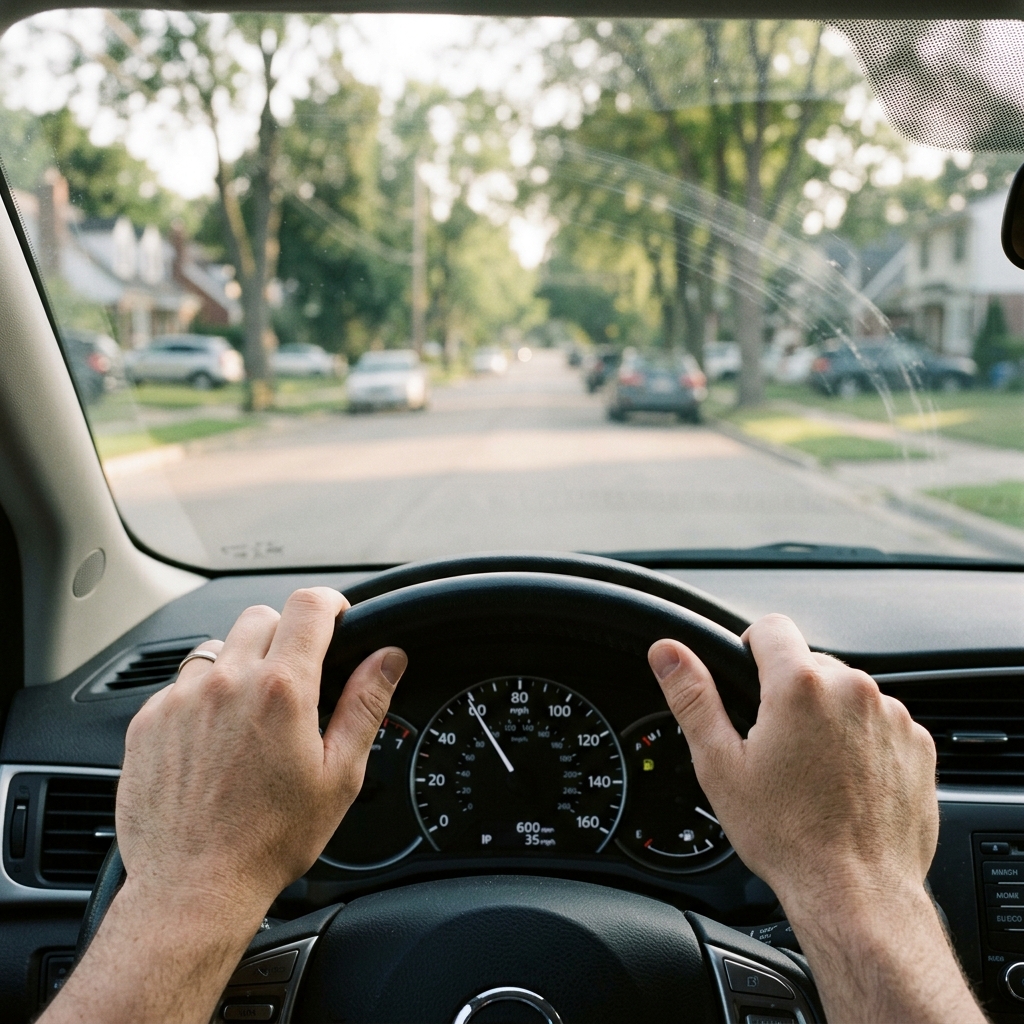
Driving Requires More Than Keeping Your Eyes on the Road
Driving is not only about steering the vehicle and looking forward. It also requires continuous mental processing.
A driver has to notice changing conditions, understand what is happening around the vehicle, identify potential hazards, make decisions, and respond appropriately.
For example, a driver may need to recognize that:
- traffic ahead is slowing;
- a pedestrian is approaching a crossing;
- another vehicle is moving into the same lane;
- a traffic signal has changed;
- the available space around the vehicle is decreasing.
Seeing these things is only part of the task. The driver must also process what they mean.
This is why a person can appear to be looking at the roadway while their attention is actually focused elsewhere. NIOSH motor-vehicle safety guidance explains that cognitive distractions can interfere with full engagement in driving even when the driver's hands are on the wheel and their eyes appear to be directed toward the road.
Where Does Your Attention Go When You Daydream?
Attention during focused driving is largely directed toward the external environment.
That can include:
- the roadway;
- nearby traffic;
- pedestrians;
- traffic signs and signals;
- vehicle movement;
- possible hazards.
Daydreaming moves part of that attention inward.
Instead of concentrating primarily on what is happening around the vehicle, the driver's thoughts may become occupied with:
- plans for later in the day;
- something that happened earlier;
- work or school;
- personal concerns;
- an imagined situation;
- a conversation.
The specific thought is not what determines the distraction type.
What matters is that mental attention has shifted away from the driving task.
That is the defining characteristic of cognitive distraction.
A Simple Way to Identify the Type of Driving Distraction
A useful way to classify a distraction is to ask: What part of the driving task has been diverted?
| Ask Yourself | What Changed? | Distraction Type |
|---|---|---|
| Did the driver's mind leave the driving task? | Mental attention shifted | Cognitive |
| Did the driver's eyes leave the roadway? | Visual attention shifted | Visual |
| Did the driver's hands leave vehicle control? | Physical control shifted | Manual |
The CDC's three-category distracted-driving framework uses the same basic distinction: cognitive distraction involves the mind, visual distraction involves the eyes, and manual distraction involves the hands.
An easy way to remember it is:
- Mind = Cognitive
- Eyes = Visual
- Hands = Manual
For daydreaming, the affected resource is the mind, which makes cognitive the correct answer.
Why Daydreaming Is Not Primarily a Visual or Manual Distraction
Daydreaming does not require the driver to look away from the road.
That separates it from a visual distraction, where visual attention moves away from driving—for example, looking down at a screen.
Daydreaming also does not require the driver to remove a hand from vehicle control.
That separates it from a manual distraction, such as reaching for an object or physically manipulating something inside the vehicle.
A person could theoretically continue looking forward and keep both hands positioned for driving while thinking deeply about something completely unrelated.
The defining change is happening in mental attention.
That is why daydreaming is classified primarily as cognitive rather than visual or manual distraction.
Other Situations That Can Pull a Driver's Mind Away From Driving
Daydreaming is one example of cognitive distraction, but the same underlying process can occur in other situations.
Examples include:
- thinking intensely about work or school;
- planning future activities;
- worrying about personal or financial problems;
- replaying an earlier conversation;
- becoming mentally absorbed in a conversation while driving.
These activities are different on the surface, but they share the same important attribute:
the driver's mind is focused on something other than driving.
This is also why the phrase mental distraction is sometimes used when explaining cognitive distraction. Both terms refer to a shift in mental focus rather than necessarily a movement of the driver's eyes or hands.
Can a Driving Distraction Fit More Than One Category?
Yes. One activity can involve several types of distraction at the same time.
The categories describe which driving resources are being diverted. They do not mean every distracting activity must fit into only one category.
Texting is a clear example.
It can involve:
- cognitive distraction because the driver is thinking about the message;
- visual distraction because the driver looks at the screen;
- manual distraction because the driver physically interacts with the device.
NHTSA's Human Factors program recognizes that distracting activities can involve more than one form of distraction.
Daydreaming is simpler to classify because its defining feature is the shift in mental attention.
Why Cognitive Distraction Can Be Harder to Notice
Visual and manual distractions often have obvious physical signs.
A driver may:
- look down;
- turn their head;
- reach for something;
- manipulate an object;
- interact with a screen.
Cognitive distraction can be less visible because the distraction may occur almost entirely within the driver's thoughts.
A daydreaming driver might still appear to:
- face forward;
- keep their hands in a normal driving position;
- avoid interacting with another object.
The outward behavior may look ordinary, while the driver's mental attention has moved away from the driving task.
This is another reason classification should focus on what resource is being diverted, rather than simply whether the distraction is easy for someone else to see.
Quick Answer Check
If you need to remember the answer for a driver's-ed, OSHA-style, or safety question, use this relationship:
Daydreaming → Mind → Cognitive Distraction
So:
Daydreaming while driving is an example of cognitive distraction.
Frequently Asked Questions
Does daydreaming count as distracted driving?
Yes. Daydreaming can be a form of distracted driving because it shifts mental attention away from operating the vehicle. The NHTSA definition of distracted driving focuses on activities that divert attention from safe driving.
Is mind wandering the same as cognitive distraction?
Not exactly. Mind wandering describes the shift of thought, while cognitive distraction describes what happens when that shift interferes with attention needed for driving.
In other words: mind wandering can cause cognitive distraction while driving.
Can a driver be cognitively distracted without using a phone?
Yes. Cognitive distraction does not require a phone or any other object. Daydreaming, planning, worrying, remembering, or becoming absorbed in a conversation can all shift mental focus away from driving.
Is thinking about work while driving a cognitive distraction?
It can be. If thinking about work occupies enough mental attention that the driver's focus shifts away from the driving task, it becomes a cognitive distraction.
The subject of the thought is less important than where the driver's attention is directed.
Does cognitive distraction always involve looking away?
No. Looking away is associated with visual distraction. Cognitive distraction concerns where the driver's mind is focused, so it can occur without the driver necessarily looking away from the road.
The CDC's distracted-driving categories distinguish cognitive distraction from visual distraction for exactly this reason.
What is the easiest way to remember the three main types of driving distraction?
Use this simple rule:
- Mind = Cognitive
- Eyes = Visual
- Hands = Manual
Since daydreaming primarily involves the mind, the correct classification is cognitive distraction.
The information in this article is for general educational purposes only and does not constitute legal advice. Every claim is unique. Always consult with a qualified professional about your specific situation.
Written by
Editorial TeamClaims Specialists
Our editorial team consists of experienced claims specialists who understand the complexities of car accident claims. We are committed to providing accurate, helpful information to accident victims navigating the claims process.